
Rosemead Previous Residents Address Sources
Each source covers a different era and shows a different relationship to one address. The table keeps the backward trail honest. Recorded real estate is strongest for title events, while directories and census schedules are better for people and households. Permits date physical work, voter registers place registered voters, and newspapers or obituaries can connect relatives and former addresses.
| Source | Years it covers | Where held | What it shows |
|---|---|---|---|
| RR/CC recorded real estate | 1850 or 1851 to present | Norwalk and copy routes | Legal ownership events, liens, maps, and parties |
| LAPL digitized directories | Selected 1875–1987 | Online Tessa collection | Printed occupant or business at covered addresses |
| California voter registrations | 1900–1968 | Library database | Registered voter, address, and variable fields by year |
| Federal census | Public through 1950 in 2026 | NARA and library databases | Household members, relationships, age, birthplace, and address |
| LA city directories | 1873–1942 | LAPL paper, film, and scans | Annual or intermittent resident and occupation evidence |
| Building permits | Exact Rosemead start not published | City Building and Safety | Construction, applicant, contractor, and date milestones |
| Newspapers and obituaries | LA Times 1881–1996 plus current sources | LAPL and newspaper archives | Death, relatives, former addresses, and community links |
Start with the address and parcel, then choose the source for the time period. A continuous resident list is not available, so the best result is a sequence of dated, named records with a stated source role.
For the county's access instructions, open the RR/CC real-estate viewing page.
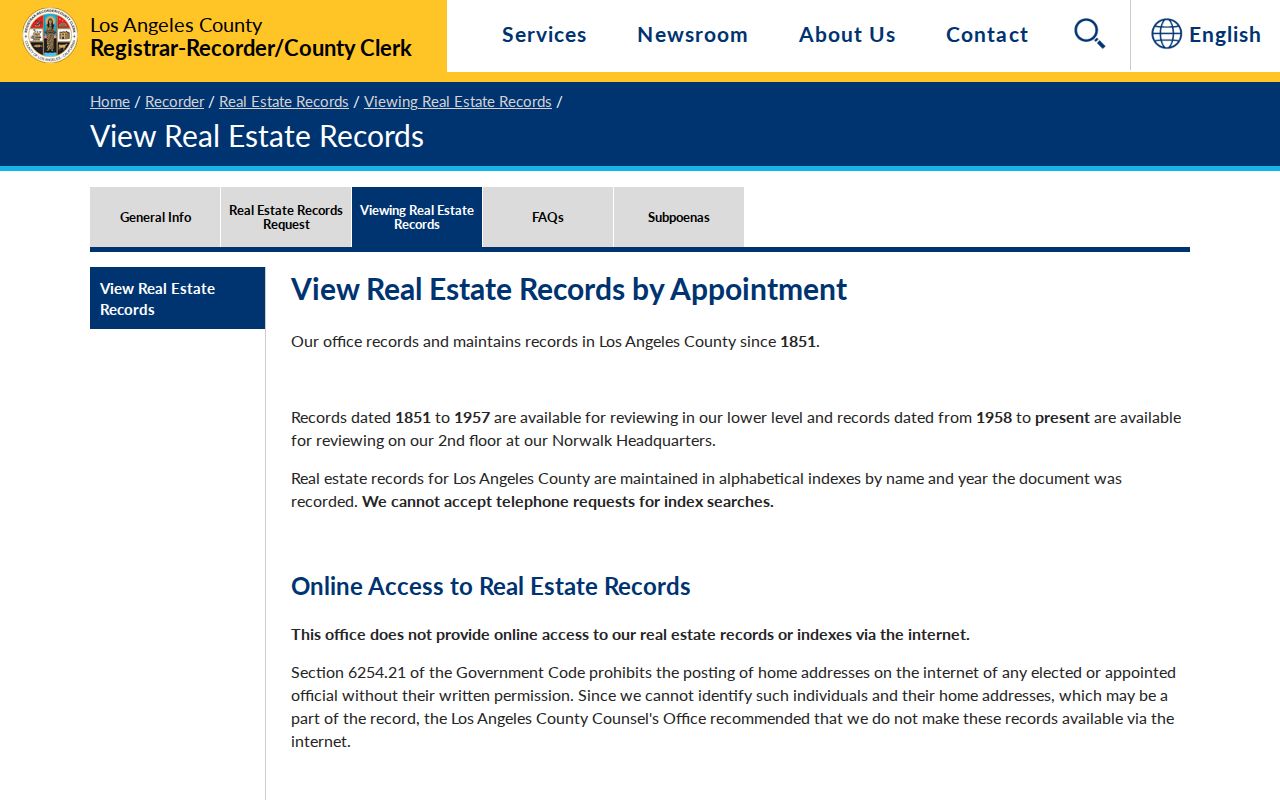
The recorder capture shows the essential starting fact for previous residents: the deed index is an in-person or written name-and-year search, not an online address lookup.
Start a Rosemead Previous Residents AIN Trail
Search the current situs address in the Los Angeles County Assessor Portal. Save the AIN, legal or map reference, property use, assessment facts, and effective date. The AIN is the durable bridge when a street name, number format, postal city, or community label changes. Compare the map to nearby parcels before assuming the present parcel is the same land described by an older source.
The current assessor card may not provide a public owner-name search. Use the applicable Assessor request route when a lawful owner record is needed. A tax mailing address is separate from situs, and neither one proves who lived in the house. Once a current deed party or lawful owner name is known, estimate the acquisition year and move to the RR/CC index.
- Record the modern address, AIN, situs, legal description, map reference, and access date.
- Identify a current grantee or other recorded party through the proper county channel.
- Search the grantee name in the approximate recording year.
- Read the instrument and copy its grantor, grantee, date, title, number, and legal description.
- Use the grantor as the next possible earlier grantee, then repeat with a narrower year.
Note: The AIN connects parcel systems, but it does not convert a property record into a resident list.
Rosemead Previous Residents Grantor-Grantee Loop
Grantor means the party transferring an interest. Grantee means the party receiving it. In a simple backward chain, the current owner appears as grantee on a purchase deed; the earlier seller appears as grantor on that deed and may appear as grantee on an older acquisition. Repeat the loop while checking the legal description, recording date, instrument number, and parcel relationship.
- Chain of title
- The sequence of recorded ownership events tied to the same land description.
- Legal description
- Title-facing language that identifies land by lot, block, tract, map, or metes and bounds.
- Instrument number
- The recorder's identifier for a recorded document.
- Recorded image
- The scanned or issued copy of the document, separate from the index line.
A chain of title is not a chain of occupancy. A buyer can acquire a property before moving in, a seller can remain connected to a different address, and a deed can include a trust, corporation, or other entity. Use directories, census schedules, voter registers, permits, and obituaries to address the household layer.
Rosemead Previous Residents Recorder Floor Divide
At the Norwalk recorder facility, records from 1851 through 1957 are reviewed on the lower level, while 1958 to the present is on the second floor. This split is a physical access instruction, not a digitization cutoff. The public index remains offline for every era. Appointments can be booked roughly two weeks ahead, and telephone index searches are not accepted.
A mail search is the fallback when travel is not practical. The RR/CC mail-search instructions require document title, every known name, an exact recording year or range, return and contact information, and payment by check or money order to Registrar-Recorder/County Clerk. Mail Real Estate Records at P.O. Box 1130, Norwalk, CA 90651-1130. The stated processing target is within 20 working days. Online copy orders use the linked LexisNexis service and add the applicable copy charge.
The instrument search can return grantor, grantee, recording date, document type, instrument number, and recorded image. The document may add legal description, AIN, return-to details, signatures, and notarial acknowledgment. A complete document must be purchased; individual pages cannot be selected.
Note: Verify the current appointment, mail, and certified-copy fee instructions before sending any request.
Rosemead Previous Residents Historical Directories, 1875–1987
LAPL's digitized Los Angeles-area city and street-address directories provide selected coverage from 1875 through 1987. Search by exact address, then browse the street section if OCR fails. Preserve the publication title, printed year, page image, community statement, and abbreviation key. The directory can show an occupant or business in a printed snapshot, but it does not prove title, continuous residence, or everyone in a household.
Use a neighboring edition to bracket arrival or departure. Test street suffixes, directions, house-number formats, surname variants, initials, and spouse names. Rosemead's earlier identity complicates the search: before incorporation in 1959, a source may use Savannah or a regional San Gabriel Valley heading. Do not modernize the printed label without explaining the match.
The collections themselves are covered in the Rosemead city directory archive. This previous-residents page uses them as one dated layer in a property trail, not as a replacement for the collection catalog.
Rosemead Previous Residents Voter Registers Between Years
California voter registrations from 1900 through 1968 can fill a gap between directory editions and census schedules. A quoted-address search in a library database may reveal a registered voter in a covered year. It does not capture minors, nonvoters, unlisted people, or later occupants. Modern voter status is self-only, and county voter files require an approved statutory purpose, signed application, payment, and certification.
Federal census schedules through 1950 add household relationships, age, birthplace, marital status, and residence-history fields appropriate to the year. The 72-year rule makes 1950 the latest public population schedule in 2026. Use enumeration-district or street tools when names are mistranscribed, and keep the census year beside every household clue.
Pair a directory, voter entry, and census schedule only after checking address format and community label. A person can appear as a voter at a mailing address, a directory occupant at a printed address, and a deed party at a legal parcel without those roles being simultaneous.
Note: A directory, census, or voter match gains meaning from its printed year and address format, not from a modern city label alone.
Rosemead Previous Residents Permits and Family Endpoints
Rosemead Building and Safety and Planning files can date construction, remodeling, inspections, applications, ownership authorization, site plans, or hearings. The public inspection form uses a known Permit Number, so an address history normally needs a targeted request by address or AIN and date range. Ask for permit number, scope, applicant, contractor, issue date, inspection milestones, and final date where public.
Newspapers and obituaries can close a past-resident trail. Start with a narrow date from a death index, directory disappearance, court filing, deed, or permit, then search the Los Angeles Times Historical Archive from 1881 through 1996 and local San Gabriel Valley sources. An obituary may connect relatives and former addresses, but it is family or newspaper evidence, not an adjudicated record. Probate files can be stronger for legal heirship.
A permit applicant may be an architect, contractor, owner, or agent. Keep that role separate from a directory occupant or deed party. The same discipline applies to an obituary's relationship language.
Rosemead Previous Residents' Savannah Continuity
Rosemead's incorporation date creates a real address-continuity problem. Earlier resident evidence may be filed under Savannah, a broad San Gabriel Valley title, a neighboring postal community, or Los Angeles County without the modern city name. A map, tract, lot, block, AIN, or institution can bridge the labels, but the source's original wording should remain visible.
Rosemead Library supplies a worked example. Savannah Branch began in a room at Savannah School in 1916, burned in 1921 and 1927, spent more than 30 years at 4114 Rosemead Boulevard, and moved to 8800 Valley Boulevard in May 1967. The succession is useful because it joins an institution, dates, and addresses across changing place labels. It does not show that county court or recorder records were destroyed.
Keep a timeline with source, printed label, address, and confidence. That makes a previous-residents search explainable when the modern city name is absent from an old volume.
Note: Rosemead's 1959 incorporation date explains why an older address trail may need Savannah and regional headings before modern confirmation.
Rosemead Previous Residents House-History Checklist
LAPL's History of Your House guide brings the pieces together: deed research, directories, voter registers, obituaries, permits, and related house-history sources. Its most important warning is practical. RR/CC needs grantor, grantee, and year and does not search deeds by address. Digitized directories permit reverse address work, while quoted addresses help with historical California voter registrations.
Use the guide to set a research order, then confirm the exact source at its custodian. The county recorder can supply the recorded document, the Assessor can clarify parcel identity, Rosemead departments can answer a targeted permit request, and the library can help locate historical images. A house history is strongest when it cites each layer instead of turning several clues into one unqualified resident name.
Open LAPL's house-history research guide for the source sequence, then keep the current parcel work on the Rosemead street directory page.
Lawful house history. A past-address trail is for personal research, family history, property curiosity, and civic use. Do not use it to stalk, harass, intimidate, or harm anyone.