
Find Rosemead Residents in the Right Records
A useful resident search begins with the strongest clue and moves outward. An address is usually the best starting point because the Los Angeles County Assessor Portal accepts a situs address or a 10-digit Assessor Identification Number, called an AIN. A name can lead to a court, business, license, vital, or historical index, but a common name needs a second identifier. The goal is not to assemble a private roster. It is to connect a person, place, date, and record role without treating one result as proof of identity.
Use the sequence below for a lawful family-history, property, civic, or reconnection question. Each step produces a better key for the next office.
- Write down the exact name, spelling variants, approximate dates, known city, and the reason for the search.
- Run an address or AIN through the Assessor Portal when a parcel is known, and save the legal or map reference.
- Use the Los Angeles Superior Court name service only after narrowing spelling and likely party role.
- Check a state business or professional-license record when an organization, trade, or license clue can separate same-name results.
- Confirm the lead with a second independent record, then contact the office that holds the source record.
Note: A directory hit is a lead until its date, role, address, and custodian record agree.
Where Rosemead Resident Records Are Kept
Rosemead is an incorporated city in Los Angeles County, but the county is not the county seat and it has no single resident-records counter. The City Clerk handles municipal documents, the Assessor handles parcel facts, the Registrar-Recorder/County Clerk handles deeds and vital copies, and the Superior Court handles case records. State offices add voter status, business filings, professional licenses, unclaimed property, and custody searches. The California Public Records Act, Government Code §§7920.000 et seq., applies to identifiable existing records held by the proper agency, not to a request that an office create a new household list.
Rosemead City Clerk
8838 E. Valley Boulevard
Rosemead, CA 91770
(626) 569-2100
Los Angeles RR/CC
Deeds, vital copies, FBNs, and clerk filings
(800) 201-8999
Access differs by record. A free web portal may show a parcel, while the deed index requires a Norwalk appointment or a written mail search. A city request may be filed online as a guest or account holder, and the library may supply a better historical lead than a current database.
Start With a Rosemead Resident Directory AIN
The Assessor Portal is the most direct Rosemead property doorway. Search by the physical situs address or by its 10-digit AIN, then compare the basic, legal, map, and parcel-detail views. The AIN is valuable because street formatting can change while the parcel key remains the bridge among assessment, tax, deed, and map records. The web card can show the situs, use, legal description or map reference, assessment values, building facts, tax-rate area, and an effective-date notice.
| Portal control | What it does in a Rosemead search |
|---|---|
| Search by AIN or Address | Accepts the parcel's 10-digit AIN or situs address. |
| Basic Search | Opens the general parcel lookup route. |
| Legal Search | Emphasizes legal-description information. |
| Map Search | Lets a reader pan, zoom, and select nearby parcels. |
| Assessor Internet | Leads to parcel detail and the displayed effective date. |
Do not turn a parcel card into a resident claim. The tax-bill mailing address and the property situs address are different fields. Even when they match, the result is evidence consistent with owner occupancy, not proof that every person at the address is the owner or that the owner is present now.
- AIN
- The Assessor Identification Number used to distinguish a parcel in county property systems.
- Situs address
- The physical location of the parcel, separate from a tax mailing address.
- Index
- A finding aid that points to a record; it is not always the full recorded image.
- Roll
- A government list organized for a defined purpose, such as assessment or voter administration.
Current Rosemead Resident Sources
No present-day source lists every Rosemead household. Current directory work is more accurate when each roll is described by what it actually proves and what it omits. The table separates a property connection from voter status, case participation, business affiliation, or a municipal document. The Los Angeles County assessor and recorder provide the property chain, while California and city offices add different kinds of public identity evidence.
| Source | Connection shown | Custodian | Access route |
|---|---|---|---|
| Assessment parcel | AIN, situs, legal/map facts, assessment data | Los Angeles Assessor | Free address or AIN portal |
| Recorded deed | Named party to a transfer, lien, or other instrument | LA RR/CC | Name/year index in Norwalk, then copy request |
| Voter status | The requesting voter's status, districts, and election information | California SOS | Self-lookup only |
| City documents | Applicants, speakers, parcel owners, contracts, or permit parties | Rosemead City Clerk and departments | Document Central or targeted request |
| Business or license file | Entity, agent, license status, public address, or discipline | California SOS or DCA | Free state search portals |
Each row answers a different question. A deed identifies a legal party, not an occupant. A license connects a person to a credential and public locality, not a home. A city agenda can name an applicant without listing a household. When the question becomes one person's identity, use the Rosemead resident lookup workflow and keep the record roles separate.
Rosemead's Norwalk Resident Records Index
Los Angeles County real-estate records reach from 1850 or 1851 to the present, but the grantor and grantee index is not an Internet name search. County guidance explains that the alphabetical index stays offline because it can expose officials' home addresses. At Norwalk, search keys are grantor name, grantee name, and recording year. The office does not search the index by street address, and telephone index searches are not accepted.
For an in-person search, make an appointment and bring a narrow year range, possible party names, and the parcel's AIN or legal description as a cross-check. Records dated 1851 through 1957 are reviewed on the lower level; 1958 to the present is on the second floor. A written mail search needs the document title, every known name, an exact recording year or range, return details, and payment by check or money order. Mail requests are addressed to Real Estate Records, P.O. Box 1130, Norwalk, CA 90651-1130, with a stated processing target within 20 working days.
Find the grantee: preserve the name and approximate acquisition year. Read the instrument: save grantor, grantee, date, title, number, and legal description. Follow the grantor: search the earlier grantee role and year to move the ownership trail backward.
Note: Online copy orders and certified-copy charges are separate from the offline index; verify the current fee before sending payment.
Rosemead City Hall Resident Records Trail
The Rosemead City Clerk is the municipal starting point for public records, not a citywide resident roll. The online platform accepts a request as a guest or through an account. An account can track the request, and prior releases can be searched before a duplicate filing. Document Central provides agendas, minutes, financial reports, bids, proposals, and other ready documents that may name an applicant, commissioner, consultant, parcel owner, or speaker.
For a property question, ask for an existing record with a defined address and date range. Building and Safety can be asked for issued permits, applicant or contractor names, scope, inspection, and final dates where releasable. Planning can hold entitlement files, ownership authorizations, site plans, and hearing packets. Business licensing belongs with Finance or City Hall. Code cases can be requested by address, but exemptions and redactions may remove a responsible party. The inspection request page exposes a Permit Number field for scheduling, not a browseable permit database.
Make the request concrete. Ask for a record type, address or parcel, and date span. The former Government Code section 6253(e), now recodified under the CPRA, does not require a city to create a new list.
City Hall is at 8838 E. Valley Boulevard, Rosemead, California 91770, and the research file lists Monday through Thursday, 7 a.m. to 6 p.m. hours. Confirm access details before traveling because department schedules and release practices can change.
Rosemead Court Resident Record Searches
Los Angeles Superior Court serves Rosemead. Its Case Access services separate a case-by-name search from a criminal defendant-name search. Civil, small claims, family, probate, and limited case summaries can return a case number, filing courthouse, filing date, case type, party roles, status, hearings, register-of-actions entries, and disposition when entered. A case-number search is free through the case-summary route, but the portal warns that web data is not the official court record.
The name service charges a card before results, including when there is no match. A guest result remains available for 24 hours, a redo window may be shorter, and purchased document images remain available for 30 days. Courthouse computers can show public electronic case material that remote access does not. Adoption, juvenile, sealed, and restricted matters may be unavailable, so no public result is not proof that no case exists.
For a federal matter, use the Central District of California through PACER. PACER needs an account and can return a case number, court, filing dates, parties, attorneys, docket text, and filings. Preserve the court, date, party role, and case number before associating a court result with a Rosemead person.
To compare the official interface, visit the Los Angeles court name-search service. A capture of its case-number route is also available from the LASC case summary page.
Review the official court name-search service before reading the Rosemead capture below.
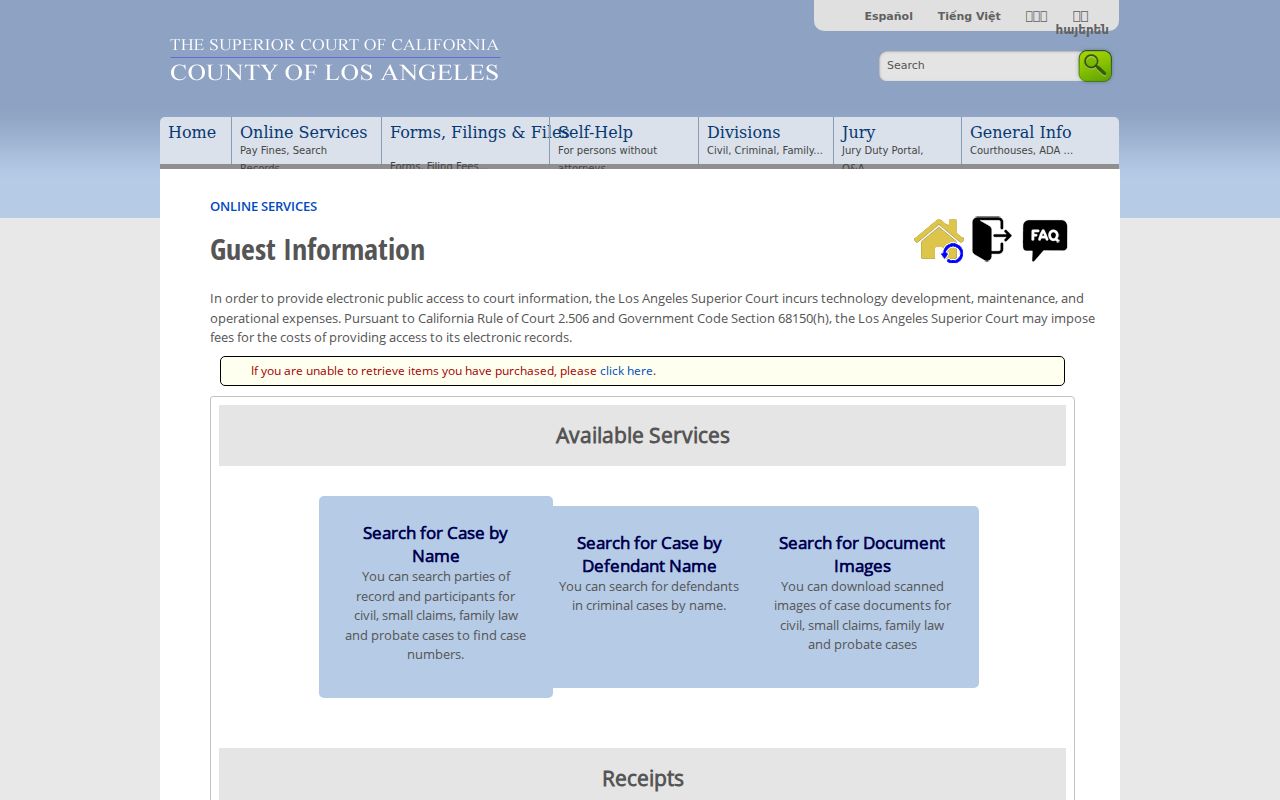
The court capture illustrates the separate name-search route and its case roles. Preserve the case number and filing courthouse when a result needs confirmation.
Note: A court party, defendant, petitioner, or witness is a record role, not a complete description of a person's life or address.
Rosemead Voter Records and Resident Status
California's My Voter Status is a private self-lookup. The voter supplies identifying fields and can see registration status, party preference, voting districts, vote-by-mail status, and election information. It is not a public neighbor browser. Los Angeles County's voter-file purchase form is limited to approved election, scholarly, journalistic, political, or governmental purposes under Elections Code §§2188 and 2194. Home address, signature, full birth date, driver-license or Social Security identifiers, and protected-voter details are not an unrestricted directory.
Historical research has a different route. LAPL and library databases provide California voter registrations from 1900 through 1968, and a quoted address can be a useful search phrase. That historical index can bridge a gap between printed directories and census schedules, but it still represents registered voters in covered years, not every person who lived at a property.
To see what the current self-service form asks for, open the California voter status lookup.
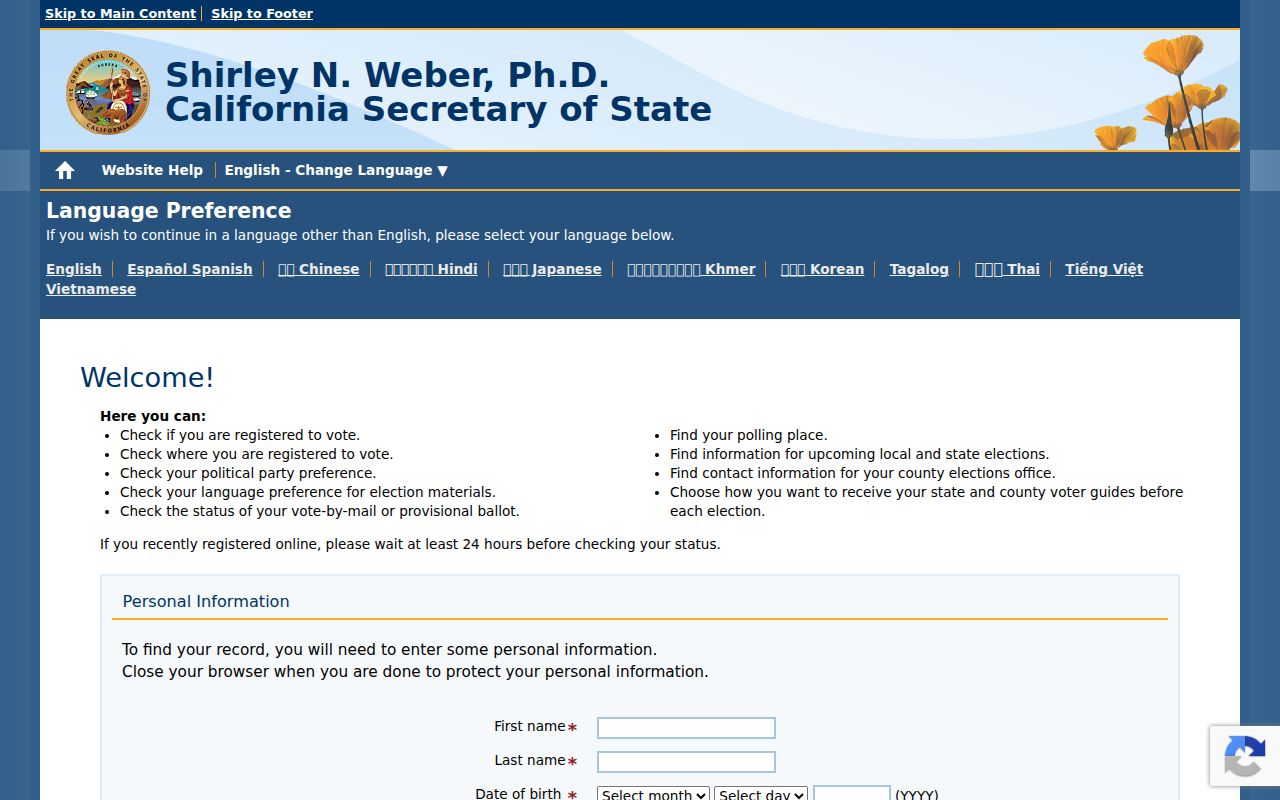
The voter-status capture shows a self-service form rather than a public street list. Keep the person-supplied lookup separate from any approved county file request.
Before trusting a missing result, account for address changes, confirmation mail, list maintenance, and Safe at Home confidentiality. The county elections contact listed in the research is 12400 Imperial Highway, Norwalk, CA 90650, (800) 815-2666, voterinfo@rrcc.lacounty.gov.
Qualified file requests use the Los Angeles County voter and election file purchase form. Address-confidential participants have a separate California Safe at Home route.
California voter status evidence works best as one timestamped clue among several. It should never be expanded into a current Rosemead household list.
Rosemead Vital Records for Resident Research
Birth, death, marriage, and divorce records do not share one access rule. Los Angeles County RR/CC is the local route for Rosemead events, while California Department of Public Health Vital Records handles statewide applications. Authorized certified birth and death copies require an eligible requester and sworn statement under Health and Safety Code §§103525 to 103526. Anyone may order an informational copy, but it is marked invalid for establishing identity. Public marriage copies are available through the proper channel; confidential marriage copies are restricted under Family Code §511. A divorce decree comes from Superior Court, not from a marriage certificate request.
Birth: LA RR/CC or CDPH, with authorized certified or informational paths, $31 in 2026. Death: LA RR/CC or CDPH, authorized or informational, $26. Public marriage: LA RR/CC or CDPH public-copy route, $19. Confidential marriage: county of issuance, with spouse or court-authorized access under Family Code §511. Divorce: Los Angeles Superior Court for the file, or CDPH for a certificate of record, $18 for the 2026 certificate.
Collect the event name, date, place, parents or spouses as applicable, requester relationship, copy type, signature, and sworn statement details before mailing. A no-record response can reflect spelling, county, date range, or delayed registration. Library indexes are finding aids, not substitutes for the actual certificate.
Rosemead Business Records and Resident Clues
Some Rosemead identity questions concern a business, professional credential, contractor, or local trade name rather than a household. California bizfile searches by entity name or file number. Advanced filters include entity type or group, status, and initial filing date, and recent filing PDFs are free. Results have a default cap of 500 closest matches, and a filing is not a certificate that every listed address remains current.
The Department of Consumer Affairs search can use board or bureau, license type, license number, business name, first or last name, registry number, city, county, status, discipline, and document filters. CSLB supports license, business, personnel, and Home Improvement Salesperson searches. These records can separate same-name people through a license number, entity number, classification, public city, or filing date. They do not establish a private residence by themselves.
bizfile: entity number, formation date, status, jurisdiction, address, agent, and filing image. DCA License Search: license identity, current or expired status, city or county, and public discipline. CSLB: business or personnel association, classification, bond, and public disclosures. LA County FBN: local fictitious business name, registrant, filing facts, and address.
When a business clue matters, save the official filing or result date. The state warns that ownership, phone, email, subsidiaries, and every relationship may not be made of record.
A Rosemead Resident Name-to-Address Check
The safest way to connect one Rosemead name to one address is to keep the sequence visible. Start with a high-specificity clue, then add a parcel or deed, then test the chronology against a second source. A middle initial, spouse or relative, AIN, license number, entity number, or consistent date range is stronger than a city name alone.
License or business filing: separates a professional or entity record, but does not prove a home address. Assessor parcel: anchors AIN, situs, and property facts, but not every occupant. Deed: confirms a recorded legal party and event, but not a move-in date. Directory, voter, or census entry: places a person or household in a covered year, but not continuous residence.
Keep contradictions in the worksheet. A deed grantee, court defendant, corporate agent, licensee, and directory householder are different roles. If an online trail ends, ask the custodian for a specific existing record, index, or date range. Corrections belong with the originating agency, not with a downstream compiler.
| Question | Official record route | Commercial compiled route |
|---|---|---|
| Source | Named custodian, collection, date, and jurisdiction | Mixed public and private data with unclear provenance |
| Identity value | Defined record role and stable identifier | May merge similar names or retain stale addresses |
| Next step | Verify with the office that holds the record | Use only as a lead, then check the official source |
Personal and lawful research only. Rosemead public records can support genealogy, property curiosity, civic review, and reconnection. Repeated contact, intimidation, stalking, or harassment is not a lawful use of an address trail.
A Rosemead Parcel in the Residents Directory
Rosemead's local numbers make the distinction clear. The 2020 to 2024 owner-occupied rate was 47.3 percent, and the average household size was about 3.42 persons. An assessor or deed result can therefore describe a nonresident owner, while a household member, visitor, or other occupant remains outside the property record. Public rolls undercount people by design because each roll serves a defined administrative purpose. Compare the Rosemead Census QuickFacts with the source role before drawing a conclusion.
For a block or street, report the source role rather than compiling a list of private individuals. A parcel map can show adjacent geometry and AINs. A permit packet can show an applicant or contractor. A directory can show an occupant in a printed year. None of those facts should be silently merged into a current resident claim.
Note: Rosemead's 5.16 square miles and compact boundary make source labels easy to confuse, so preserve the agency, date, and jurisdiction with every hit.
Rosemead's Historical Resident Trail
The Los Angeles Public Library provides the historical bridge for Rosemead. Its digitized Los Angeles-area city and street-address directories cover selected years from 1875 through 1987 and can be searched by name or address. LAPL also holds Los Angeles city directories from 1873 through 1942, telephone directories, census tools, newspapers, California death and marriage indexes, and California voter registrations from 1900 through 1968. The regional collection is not proof that every community appears in every year, so check a volume's title page and coverage statement.
Rosemead's older identity adds a local caution. The city incorporated on August 4, 1959, and earlier entries may use Savannah, a regional San Gabriel Valley heading, or a neighboring community label. Rosemead Library's own succession from Savannah Branch to 4114 Rosemead Boulevard and then 8800 Valley Boulevard demonstrates why name, address, date, and institution must be reconciled. The full historical shelf belongs on the Rosemead city directory collections page.
Use an exact address first, then browse the street-address section when OCR misses a number. Pair directory years with 1940 and 1950 census schedules, historical voter registrations, newspapers, deeds, permits, and obituaries. A missing entry is not negative proof: the household may be unlisted, the area may fall outside that volume, or the name may be filed under a spouse or initial.
Rosemead Postal Records and City Lines
ZIP geography can help organize a Rosemead search, but a ZIP Code is a delivery route rather than a municipal boundary. USPS identifies 91770 as the principal Rosemead postal ZIP. Nearby 91780 is associated with the Temple City Post Office and boundary-area addresses, so an address-level USPS check is needed before treating it as a Rosemead location. The Assessor Portal answers a parcel question; city or county planning answers a jurisdiction question.
Rosemead also touches Temple City, San Gabriel, Monterey Park, El Monte, South El Monte, and unincorporated South San Gabriel areas. County planning maps can label an unincorporated zoned district "Rosemead" even when City of Rosemead departments do not hold the record. Keep postal city, incorporated boundary, county planning area, and parcel situs as separate fields in a research note.
For a boundary-edge address, run the complete address through USPS ZIP Code Lookup, then compare the standardized situs with the assessor map and the responsible city or county office. That three-part check prevents a postal label from becoming an invented resident roll.
Recent Changes in Rosemead Records
Record systems change while old citations and screenshots remain online. California's CPRA moved from former Government Code §§6250 et seq. to §§7920.000 et seq. in 2023. CDPH certified-copy fees rose on January 1, 2026 to $31 for birth, $26 for death, $19 for marriage, and $18 for a divorce certificate. California business searches also began transitioning newly formed entities to 12-character identifiers beginning with B in late 2025, while older identifiers remain valid.
Rosemead's December 2024 planning and zoning work created a recent set of parcel-specific hearing records. A January 2025 RR/CC emergency notice described no-cost replacement records for people directly affected by county fires, with different eligibility rules for vital and property records. These initiatives may expire or change. Check the named custodian before relying on a fee, emergency service, or portal status.
Note: Capture the portal name, URL, access date, and effective date whenever a record result may be cited later.