
Rosemead City Directory Collections by Era
The first question is which collection can actually cover the address and year. LAPL's holdings combine regional city and street directories, Los Angeles city volumes, telephone books, census material, voter registrations, newspapers, and vital indexes. The dates below are verified collection windows, not a promise that every Rosemead block appears in every volume. Read the title page and community statement before treating an entry as local evidence.
| Collection | Years | Where held | Access |
|---|---|---|---|
| Los Angeles-area city and street directories | Selected 1875–1987 | LAPL Tessa digital collections | Free name and address search |
| Los Angeles city directories | 1873–1942 | LAPL History & Genealogy | Paper, film, and many digitized volumes |
| U.S. city directories | 1861–1960 | LAPL Central | Reference use; more than 5,000 microfilm rolls |
| U.S. telephone directories | 1976–2005 microfiche; LA books from 1914 | LAPL Central | In person, with older paper books |
| California voter registrations | 1900–1968 | Library database | Quoted-address searching in covered records |
| Federal census | Public through 1950 in 2026 | LAPL, NARA, and licensed databases | Household schedules and finding aids |
| California death and marriage indexes | 1905–1994; 1949–1986 | LAPL and databases | Historical index, not the certificate |
Open the LAPL City Directory Index before choosing a year. Its catalog fields include keyword, city or community, county, state or province, and region. The index is a finding aid; the digitized image is the evidence to cite.
That index view is useful because it separates catalog discovery from page reading. A Rosemead city directory entry should be tied to the publication title, printed year, page image, and community coverage statement.
Use the LAPL directory index before reading the catalog capture below.
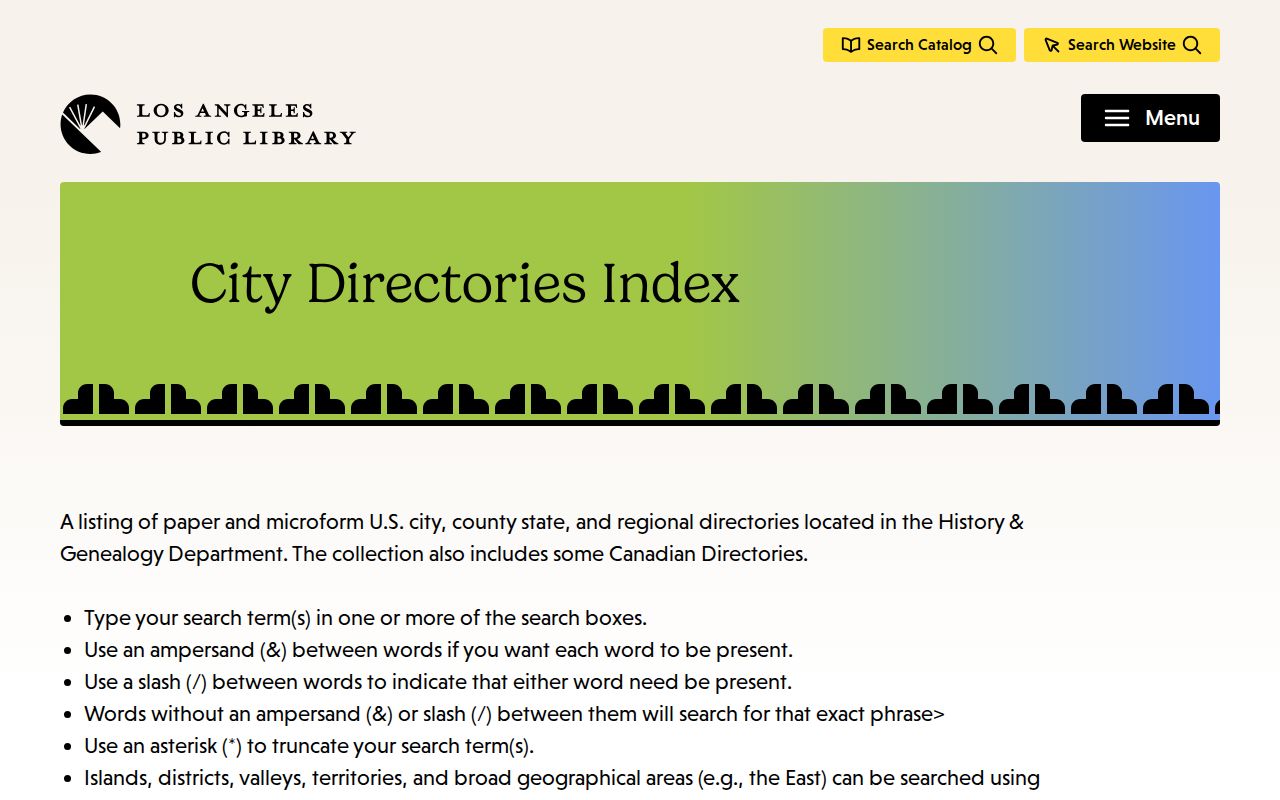
The LAPL index capture shows the catalog layer that leads to a city directory volume. Use it to locate a title, then inspect the scanned page before recording a name or address.
Rosemead City Directory's 1875–1987 Window
The most useful online Rosemead city directory collection is the digitized Los Angeles-area city and street-address run, with selected volumes spanning 1875 through 1987. It supports searching by name or address, which makes it possible to move from a known person to a printed residence or from a house number to a possible occupant. The span is wide, but availability is uneven. Regional labels do not mean Rosemead appears in every year.
Search several forms of a street name. Drop punctuation, test direction abbreviations, try a surname variant, and search the street-address pages when OCR misses a number. For a family-history question, preserve the image rather than relying on a text snippet. For a property question, compare a directory address with an AIN and legal description because a printed number can be renumbered or attached to a rear unit.
Rosemead incorporated on August 4, 1959. Earlier directories may use Savannah, a regional San Gabriel Valley heading, or a neighboring community name. A directory's community label is part of the source, not a detail to silently modernize.
See the LAPL digitized city and street directory collection for the search and image route.
The digitized collection capture underscores the difference between a searchable scan and a complete modern resident list. Coverage, OCR, and printed omissions all need to stay visible in the citation.
Note: A digitized page proves what the scanned volume printed, while its catalog coverage still controls how broadly the result can be interpreted.
Rosemead Regional City Directory Titles
The research verified a regional directory title grouping Monterey Park, Rosemead, San Gabriel, and Temple City through a commercial microfilm catalog, but an official public catalog did not establish every individual year or publisher. That gap matters. A page should not claim a continuous Rosemead series until LAPL's index or History & Genealogy staff confirm the title page and run.
Use the regional search fields first: Keyword, City or Community, County, State or Province, and Region. An ampersand joins terms as AND, a slash can express OR, and an asterisk supports truncation. Once a likely volume appears, inspect the title page, publisher statement, included communities, publication year, and page sequence. Record an uncertain result as a lead rather than filling the gap with an assumed year.
Rosemead's boundary history makes this method important. Before incorporation, the same household may be described under Savannah or a wider San Gabriel Valley heading. A post-1959 city label does not rewrite the historical source. Keep the printed label, then explain the modern relationship in a note.
Use the LAPL genealogy research guide for the broader catalog and database shelf shown below.
LAPL's genealogy research capture points toward the broader shelf that supports a city directory search. It is a reminder to test county and regional terms when a direct Rosemead query returns no volume.
Note: Exact Rosemead regional volume years and the original publisher remain a catalog-confirmation task, so do not infer a continuous run.
Decode a Rosemead City Directory Entry
A mid-century city directory entry can contain a surname, given name or initial, spouse in parentheses, occupation, work address, residence address, and short status marks. Common abbreviations include h for householder or home, r for resides or rooms, and wid for widow. A street-address or criss-cross section reverses the order, placing the street and number before the occupant or business.
Telephone directories are thinner. They may show a subscriber, address, and phone number while omitting unlisted households. Treat the printed form as a publication snapshot. It may reflect information gathered before publication, and it does not prove title, continuous residence, or every person in a household.
| Printed field | How to interpret it |
|---|---|
| Name and initials | Indexed identity; test spouse, surname, and name-order variants. |
| Residence address | Printed location for the edition, subject to coverage and timing. |
| Occupation or work address | Context that can separate same names, not a home address. |
| Spouse or household mark | A clue to family association, not a complete household roster. |
| Abbreviation key | The source's definition of marks such as h, r, or wid. |
- Criss-cross directory
- A reverse section that starts with a street address and points to a listed occupant or business.
- Householder mark
- A printed abbreviation showing a home or principal resident entry in that edition.
- OCR
- Machine reading of a scanned page, useful for discovery but vulnerable to column and name errors.
- Finding aid
- A catalog or index that helps locate a source without being the full source itself.
Compare the entry with the LAPL house-history workflow before using the capture below.
The house-history capture pairs naturally with a city directory entry: address, deed, voter, obituary, and permit clues should be kept as separate evidence lines.
Note: An abbreviation key and page image should travel with every city directory citation because OCR alone can flatten the entry's meaning.
Reverse a Rosemead City Directory Address
Address searching is often harder than name searching. Narrow columns, broken type, initials, hyphens, and non-English names can defeat OCR. Start with a normalized street name and number. If no result appears, browse the alphabetical street-address pages, scan adjacent house numbers, and compare the image with the text layer. Preserve the page image, page number, and printed abbreviation key.
Use an address change as a research question, not a conclusion. A street can cross a boundary, a parcel can be split, a rear unit can be numbered differently, or a source can use an older community label. The Los Angeles County Assessor AIN and legal description can help bridge the modern parcel, while a map or deed can test whether the printed address points to the same land.
A missed entry may mean the family was unlisted, the volume did not cover the community, the person was filed under a spouse or initial, or the directory was compiled before a move. Search adjacent editions and compare the census, voter register, newspaper, and deed trail before calling a gap evidence of absence.
Rosemead City Directory Business Clues
A city directory can list a business or work address, and a state filing can help confirm the organization behind that line. California bizfile searches an entity name or file number and can return entity number, filing date, status, jurisdiction, address, agent, and recent filing PDFs. Advanced filters cover entity type or group, status, and initial filing date. Results default to the 500 closest matches, so refine a broad term.
Business records are useful when a directory entry has a common name or a storefront address. They are not a substitute for a household record. The Secretary of State warns that ownership, phone, email, and subsidiaries may not be made of record. Save the official filing image and date, and keep the entity role beside the directory entry.
Review the California business search and the bizfile program information before interpreting a filing.
This business-search capture shows a companion route for a directory name or storefront. It adds an entity trail, not a claim about every person at an address.
Read the California bizfile program information before interpreting the second capture.
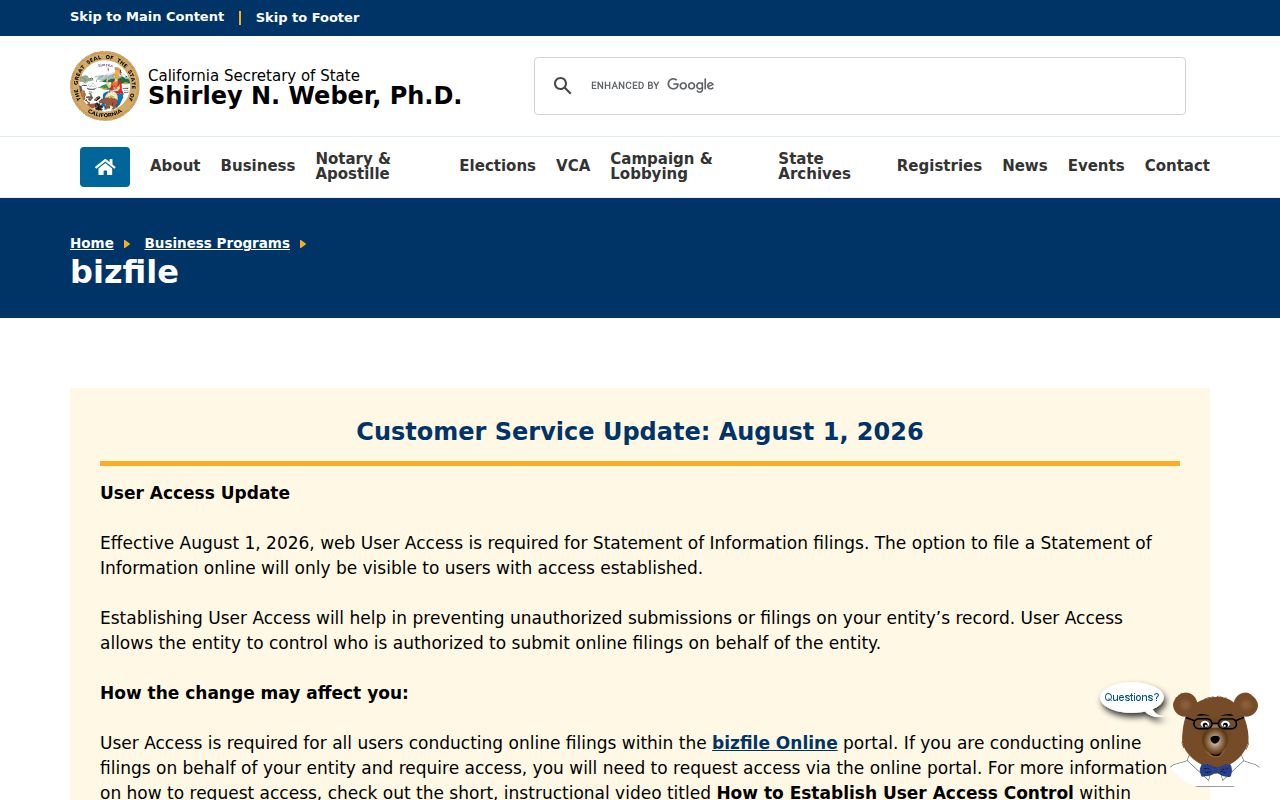
The bizfile information capture supplies the state program context. Cite the filing and city directory separately when both are used.
Pair Rosemead Directories With Census Years
To trace a household, begin with one readable directory entry and write down the exact title, year, page, address, names, and abbreviations. Search the next available edition, not just the next calendar year, because regional volumes can be intermittent. Then pair the directory with the 1940 or 1950 census schedule when the address or enumeration district can be identified.
- Normalize the street and determine whether the edition covers the Rosemead or Savannah area.
- Search the digitized run by name and address, then browse the street section if OCR misses the entry.
- Record the page image and entry fields, including spouse, occupation, household mark, and printed address.
- Compare the nearest directory editions with the 1940 and 1950 census household schedule.
- Use California voter registrations from 1900 through 1968, deeds, permits, newspapers, and obituaries to test arrival, departure, and family links.
The 72-year public-release rule makes 1950 the latest public population schedule in 2026. Later aggregated Census data can describe Rosemead, but it does not identify residents. A directory gap after 1950 needs a different source, not a guessed continuation.
Rosemead City Directory Library Trail
Rosemead Library supplies a useful local-history anchor. It began as Savannah Branch in one room of Savannah School in June 1916, burned in 1921 and 1927, spent more than 30 years at 4114 Rosemead Boulevard, and moved to the current 8800 Valley Boulevard building in May 1967. Those address changes demonstrate how an institution can help test a directory search across changing place names.
The branch has a microfilm reader, scanner, printer, newspapers, public computers, online databases, and research help. Current research lists Tuesday and Wednesday noon to 8 p.m., Thursday through Saturday 10 a.m. to 6 p.m., and closure Sunday and Monday. Confirm before visiting. The Asian Pacific Resource Center can also help interpret local community history and name-order variations without turning a surname into an assumption about a person.
For deeper genealogy, LAPL Central reports about 52,000 genealogy titles, around 14,000 family histories, more than 700 periodicals, Ancestry Library Edition, HeritageQuest, HistoryGeo, and related indexes. Staff do not perform genealogical or obituary searches, but they can identify collections and researchers.
Use the Rosemead Library information for local access and hours.
Cite a Rosemead City Directory Entry Correctly
A strong city directory citation lets another researcher find the same page. Record the publication title, edition or printed year, publisher when shown, page number, image or scan location, community statement, search terms, and access date. Add a short note when the address was indexed under Savannah or a regional heading. If OCR and the image disagree, cite the image and mention the correction.
Separate publication evidence from modern interpretation. An entry can show a person printed at an address, while a deed can show a legal transfer and an assessor card can show a parcel. The full current address chain belongs on the Rosemead street directory page. If the historical entry must be confirmed against one person's modern record, use the Rosemead resident lookup workflow rather than treating the old directory as current.
Note: A missing directory line can reflect coverage, omission, timing, or filing order; it is not proof that a Rosemead household did not exist.