
Find Rosemead Residents in the Right Records
Rosemead sits inside Los Angeles County, and its public records live in several different offices. The county assessor offers a free online parcel lookup by address or parcel number. That lookup anchors most property questions in a Rosemead residents directory search. Deeds are harder, since the Registrar-Recorder keeps its grantor and grantee index offline. Tracing past residents who bought or sold a home takes an appointment in Norwalk or a written request by mail. Court cases can be found by case number at no charge. A name search costs a fee, though. Library shelves hold old street directory volumes. Those are the friendliest corner for anyone hoping to find who lives on a street in Rosemead or learn who lived there decades ago.
- Write down the exact name, spelling variants, approximate dates, known city, and the reason for the search.
- Run an address or AIN through the Assessor Portal when a parcel is known, and save the legal or map reference.
- Use the Los Angeles Superior Court name service only after narrowing spelling and likely party role.
- Check a state business or professional-license record when an organization, trade, or license clue can separate same-name results.
- Confirm the lead with a second independent record, then contact the office that holds the source record.
Note: A directory hit is a lead until its date, role, address, and custodian record agree.
Where Rosemead Resident Records Are Kept
Rosemead sits inside Los Angeles County as an incorporated city. No single counter holds its resident records, though. The City Clerk keeps municipal documents. The Assessor keeps parcel facts. The Registrar-Recorder/County Clerk holds deeds and vital copies, and the Superior Court holds case records. State offices layer on voter rolls, business filings, professional licenses, unclaimed property, and custody searches. The California Public Records Act, Government Code §§7920.000 et seq., covers identifiable existing records. It applies to records held by the proper agency. It does not require an office to create a new household list for a requester.
Rosemead City Clerk
8838 E. Valley Boulevard
Rosemead, CA 91770
(626) 569-2100
Los Angeles RR/CC
Deeds, vital copies, FBNs, and clerk filings
(800) 201-8999
Access rules vary by record type. A free web portal may show a parcel. The deed index demands a Norwalk appointment or a written search by mail. A city request can be filed online as a guest or an account holder. For older households, the library often beats any current database.
Start With a Rosemead Resident Directory AIN
The Assessor Portal is the straightest doorway into Rosemead property records. Search by the physical situs address or its 10-digit AIN. Then compare the basic, legal, map, and parcel-detail views side by side. The AIN earns its keep. Street formatting can shift over the years. The parcel key stays stable as the bridge among assessment, tax, deed, and map records. The web card itself can display the situs, land use, legal description or map reference, assessment values, building facts, tax-rate area, and an effective-date notice.
| Portal control | What it does in a Rosemead search |
|---|---|
| Search by AIN or Address | Accepts the parcel's 10-digit AIN or situs address. |
| Basic Search | Opens the general parcel lookup route. |
| Legal Search | Emphasizes legal-description information. |
| Map Search | Lets a reader pan, zoom, and select nearby parcels. |
| Assessor Internet | Leads to parcel detail and the displayed effective date. |
Never turn a parcel card into a resident claim. The tax-bill mailing address and the property situs address are separate fields. Even a match between them only shows evidence consistent with owner occupancy, not that the owner lives there now or that everyone at the address holds title.
- AIN
- The Assessor Identification Number used to distinguish a parcel in county property systems.
- Situs address
- The physical location of the parcel, separate from a tax mailing address.
- Index
- A finding aid that points to a record; it is not always the full recorded image.
- Roll
- A government list organized for a defined purpose, such as assessment or voter administration.
Current Rosemead Resident Sources
No present-day roll lists every Rosemead household. Directory work goes better when each source is judged by what it proves. It also matters what a source leaves out. A property connection differs from voter status. It also differs from case participation, a business affiliation, or a mention in a municipal document. The Los Angeles County assessor and recorder supply the property chain. California and city offices add other kinds of public identity evidence.
| Source | Connection shown | Custodian | Access route |
|---|---|---|---|
| Assessment parcel | AIN, situs, legal/map facts, assessment data | Los Angeles Assessor | Free address or AIN portal |
| Recorded deed | Named party to a transfer, lien, or other instrument | LA RR/CC | Name/year index in Norwalk, then copy request |
| Voter status | The requesting voter's status, districts, and election information | California SOS | Self-lookup only |
| City documents | Applicants, speakers, parcel owners, contracts, or permit parties | Rosemead City Clerk and departments | Document Central or targeted request |
| Business or license file | Entity, agent, license status, public address, or discipline | California SOS or DCA | Free state search portals |
Each row in the table answers a different question. A deed names a legal party, not an occupant. A license ties a person to a credential and a public locality, not a home. A city agenda can name an applicant while saying nothing about a household. The question sometimes narrows to one person's identity. The Rosemead resident lookup workflow keeps those record roles separate.
Rosemead's Norwalk Resident Records Index
Los Angeles County real-estate records reach back to 1850 or 1851. But the grantor and grantee index is not an internet name search. County guidance explains that the alphabetical index stays offline. It can expose officials' home addresses. At Norwalk, the search keys are grantor name, grantee name, and recording year. The office does not search the index by street address. It takes no index searches over the telephone.
For an in-person visit, make an appointment. Bring a narrow year range, possible party names, and the parcel's AIN or legal description as a cross-check. Records dated 1851 through 1957 are reviewed on the lower level. Records from 1958 to the present sit on the second floor. A written mail search needs the document title, every known name, an exact recording year or range, return details, and payment by check or money order. Address mail requests to Real Estate Records, P.O. Box 1130, Norwalk, CA 90651-1130, with a stated processing target within 20 working days.
Find the grantee: save the name and the approximate acquisition year. Read the instrument: record grantor, grantee, date, title, number, and legal description. Follow the grantor: search the earlier grantee role and year to push the ownership trail backward.
Note: Online copy orders and certified-copy charges are separate from the offline index; verify the current fee before sending payment.
Rosemead City Hall Resident Records Trail
The City Clerk anchors Rosemead's public records desk. It is not a citywide resident roll. You can file as a guest or open an account. The account tracks your request and lets you search prior releases before filing anything that duplicates an earlier one. Document Central adds agendas, minutes, financial reports, bids, proposals, and other ready documents, many of which name an applicant, commissioner, consultant, parcel owner, or public speaker.
Property questions need an existing record. Give a defined address and a date range. Building and Safety can release issued permits with applicant or contractor names, project scope, inspection dates, and finals where releasable. Planning keeps entitlement files, site plans, and hearing packets. Planning can also hold ownership authorizations. Business licensing sits with Finance or City Hall. Code cases can be requested by address, but exemptions and redactions may remove the responsible party. The inspection request page exposes a Permit Number field for scheduling, not a browseable permit database.
Make the request concrete. Ask for a record type, address or parcel, and date span. The former Government Code section 6253(e), now recodified under the CPRA, does not require a city to create a new list.
City Hall sits at 8838 E. Valley Boulevard, Rosemead, California 91770, and public counters operate Monday through Thursday, 7 a.m. to 6 p.m. Call ahead before visiting. Department schedules and record-release practices change from time to time.
Rosemead Court Resident Record Searches
Rosemead sits inside the reach of the Los Angeles Superior Court. Its Case Access portal splits lookups into two paths. One searches civil cases by a party name. The other hunts for a criminal defendant by name. Results vary by case type. They can include a case number, the courthouse where the file landed, filing date, party roles, current status, hearing dates, register-of-actions entries, and any disposition on record. Case-number searches through the summary route cost nothing. The portal itself cautions that what appears online is not the official court record. Treat it as a pointer rather than the file itself.
The name-based service works differently. It charges a card up front, even when nothing matches. A guest result stays viewable for 24 hours. The redo window can run shorter. Purchased document images last 30 days. Courthouse terminals open up public electronic case material that remote access will not show. Adoption, juvenile, sealed, and restricted matters stay hidden. An empty result never proves a case does not exist.
Federal cases follow a separate road. PACER serves the Central District of California and requires an account. It can return the case number, court, filing dates, parties, attorneys, docket text, and filed documents. Before tying any court result to a Rosemead person, record the court, the date, the party role, and the case number.
To see the official interface, visit the Los Angeles court name-search service. Its case-number route is also documented on the LASC case summary page. Anyone pairing court output with a Rosemead residents directory entry should confirm details through the official court name-search service first.
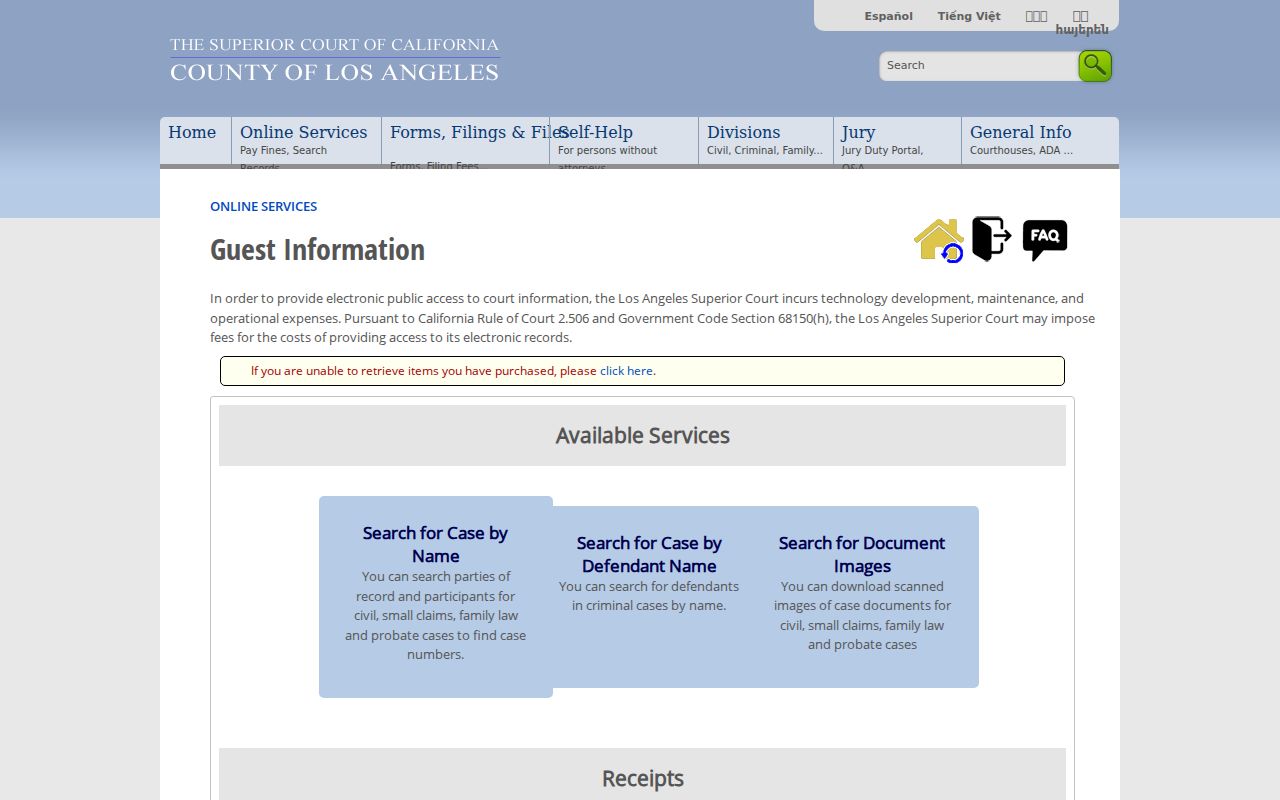
The court page illustrates the separate name-search route and its case roles. Preserve the case number and filing courthouse when a result needs confirmation.
Note: A court party, defendant, petitioner, or witness is a record role, not a complete description of a person's life or address.
Rosemead Voter Records and Resident Status
California's My Voter Status tool is a private self-lookup. A voter enters identifying fields and sees registration status, party preference, voting districts, vote-by-mail status, and election information. It is not a public neighbor browser. Los Angeles County limits voter-file purchases to approved election, scholarly, journalistic, political, or governmental purposes under Elections Code §§2188 and 2194. Home addresses, signatures, full birth dates, driver-license or Social Security identifiers, and protected-voter details never form an unrestricted directory.
History opens a different door. LAPL and its library databases hold California voter registrations from 1900 through 1968. A quoted address makes a strong search phrase. That index can bridge printed directories and census schedules. It still counts only registered voters. Not every Rosemead resident appears. To see what the self-service form asks, open the California voter status lookup.
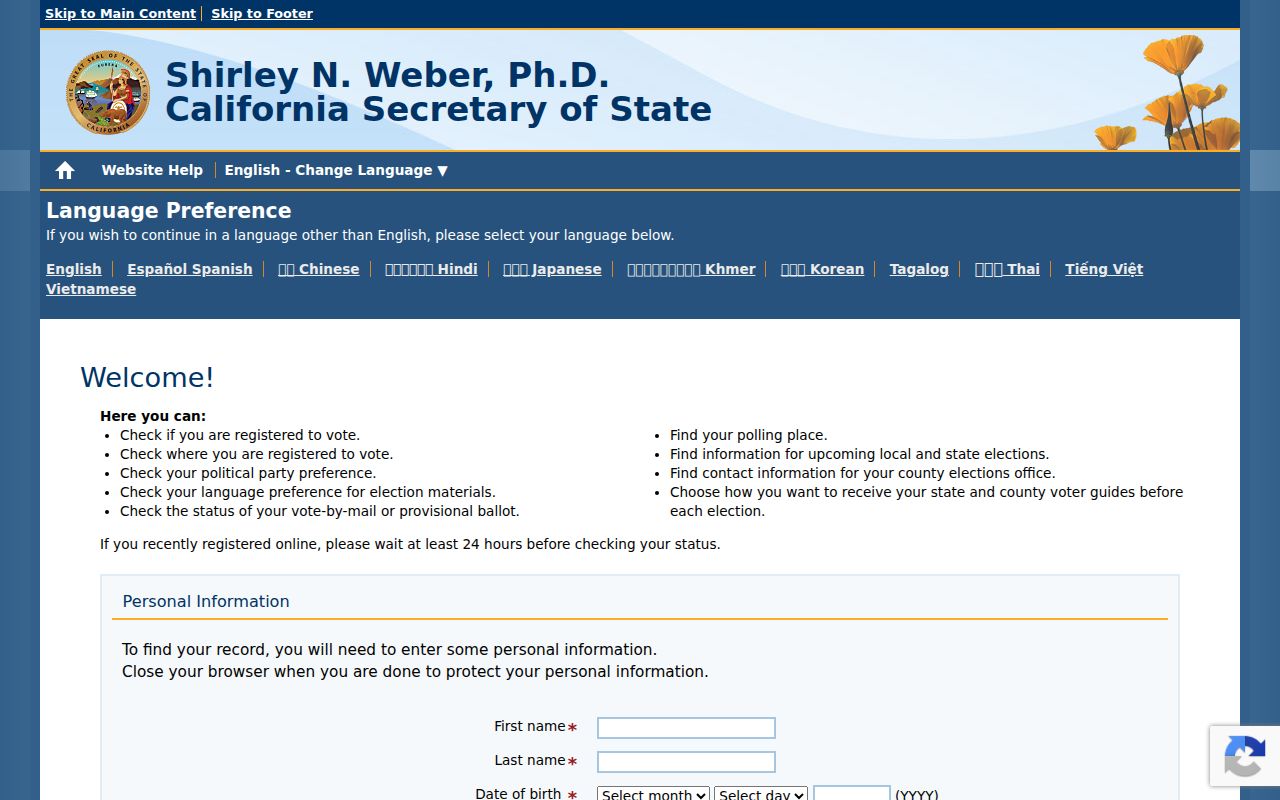
The voter-status page is a self-service form. It is no public street list. Keep it separate from any approved county file request.
A missing result has innocent explanations. Address changes, confirmation mail, list maintenance, and Safe at Home confidentiality can all hide a registration. The county elections office can be reached at 12400 Imperial Highway, Norwalk, CA 90650, (800) 815-2666, voterinfo@rrcc.lacounty.gov.
Qualified requesters file through the Los Angeles County voter and election file purchase form. Address-confidential participants have a separate California Safe at Home route.
Treat voter status as one timestamped clue among several. It should never stand in for a current Rosemead household list.
Rosemead Vital Records for Resident Research
Birth, death, marriage, and divorce records each follow their own access rules. Los Angeles County RR/CC is the local route for Rosemead events. The California Department of Public Health Vital Records office handles statewide applications. Authorized certified birth and death copies require an eligible requester. They also require a sworn statement under Health and Safety Code §§103525 to 103526. Anyone may order an informational copy, though it is marked invalid for establishing identity. Public marriage copies flow through the proper channel. Confidential marriage copies stay restricted under Family Code §511. A divorce decree comes from Superior Court, not from a marriage certificate request.
Birth: LA RR/CC or CDPH, authorized certified or informational paths, $31 in 2026. Death: LA RR/CC or CDPH, authorized or informational, $26. Public marriage: LA RR/CC or CDPH public-copy route, $19. Confidential marriage: county of issuance, with spouse or court-authorized access under Family Code §511. Divorce: Los Angeles Superior Court for the file. Or CDPH for a certificate of record, $18 for the 2026 certificate.
Before mailing anything, gather the event name, date, place, parents or spouses as applicable. Add your relationship, copy type, signature, and sworn statement details. A no-record response can trace back to spelling, county, date range, or delayed registration. Library indexes are finding aids, never substitutes for the actual certificate.
Rosemead Business Records and Resident Clues
Some Rosemead identity questions point to a business, a professional credential, a contractor, or a local trade name rather than a household. California bizfile searches by entity name or file number. Advanced filters cover entity type or group, status, and initial filing date. Recent filing PDFs are free. Results cap at 500 closest matches. A filing never certifies that every listed address stays current.
The Department of Consumer Affairs search works from many angles: board or bureau, license type and number, business name, first or last name, registry number, city, county, status, discipline, and document filters. CSLB adds license, business, personnel, and Home Improvement Salesperson searches. These records separate same-name people well. A license number, entity number, classification, public city, or filing date breaks the tie. They do not establish a private residence.
Bizfile covers the entity record. DCA License Search shows license identity, current or expired status, city or county, and public discipline. CSLB shows business or personnel association, classification, bond, and public disclosures. LA County FBN shows a local fictitious business name, registrant, filing facts, and address. The bizfile entry carries the entity number, formation date, status, jurisdiction, address, agent, and filing image.
Save the official filing or result date. That detail anchors any business clue. The state itself warns that ownership, phone, email, subsidiaries, and every relationship may not be made of record.
A Rosemead Resident Name-to-Address Check
Keep the sequence visible. Start with a high-specificity clue. Add a parcel or deed. Then test the chronology against a second source, since a middle initial, spouse, AIN, license number, entity number, or consistent date range carries more weight than a city name alone.
A license or business filing separates a professional or entity record but proves no home address. An assessor parcel anchors the AIN, situs, and property facts, yet not every occupant. A deed confirms a recorded legal party and event. It is not a move-in date. A directory, voter, or census entry places a household in one covered year. No single source proves continuous residence.
Keep contradictions in the worksheet. A deed grantee, court defendant, corporate agent, licensee, and directory householder play different roles, so when an online trail ends, ask the custodian for a specific existing record, index, or date range. Corrections belong with the originating agency.
| Question | Official record route | Commercial compiled route |
|---|---|---|
| Source | Named custodian, collection, date, and jurisdiction | Mixed public and private data with unclear provenance |
| Identity value | Defined record role and stable identifier | May merge similar names or retain stale addresses |
| Next step | Verify with the office that holds the record | Use only as a lead, then check the official source |
Personal and lawful research only. Rosemead public records can support genealogy, property curiosity, civic review, and reconnection. Repeated contact, intimidation, stalking, or harassment is not a lawful use of an address trail.
A Rosemead Parcel in the Residents Directory
Rosemead's own numbers show why the distinction matters. From 2020 to 2024 the owner-occupied rate was 47.3 percent, and the average household size ran about 3.42 persons. An assessor or deed result can therefore describe a nonresident owner, while a household member, visitor, or other occupant stays outside the property record. Public rolls undercount people by design. Each one serves a defined administrative purpose. Compare the Rosemead Census QuickFacts against the source role before drawing any conclusion.
For a block or street, report the source role instead of compiling a list of private individuals. A parcel map shows adjacent geometry and AINs. A permit packet shows an applicant or contractor. A directory shows an occupant in a printed year. None of those facts should merge silently into a current resident claim.
Note: Rosemead's 5.16 square miles and compact boundary make source labels easy to confuse, so preserve the agency, date, and jurisdiction with every hit.
Rosemead's Historical Resident Trail
The Los Angeles Public Library anchors any historical resident lookup for Rosemead. Its digitized directories are the key. They cover selected years from 1875 through 1987 across the Los Angeles area. Search by name or by address. LAPL's shelves hold far more than street directories. Los Angeles city directories run from 1873 through 1942, alongside telephone directories, census tools, and newspapers. California death and marriage indexes sit nearby, plus voter registrations from 1900 through 1968. Not every community appears in every volume. Check the title page and coverage statement first.
Rosemead's past carries a naming trap. The city incorporated on August 4, 1959. Before that, directory headings may read Savannah, a broader San Gabriel Valley label, or a neighboring community instead. The library's own history proves the point. Rosemead Library began as Savannah Branch, moved to 4114 Rosemead Boulevard, and later landed at 8800 Valley Boulevard. Reconcile the name, address, date, and institution together. The full historical shelf lives on the Rosemead city directory collections page.
Start with an exact address. When OCR misses a number, browse the street-address section instead. A residents directory entry pairs well with the 1940 and 1950 census schedules. Historical voter registrations, newspapers, deeds, permits, and obituaries all add corroboration. A missing entry proves nothing. The household may simply be unlisted. The area may fall outside that volume. Or the name may hide under a spouse or an initial.
Rosemead Postal Records and City Lines
A ZIP Code is a delivery route, not a municipal boundary. ZIP geography still helps organize a Rosemead search. USPS lists 91770 as the principal Rosemead postal ZIP. Nearby 91780 belongs to the Temple City Post Office. It also covers boundary-area addresses, so check an address with USPS before treating it as Rosemead. The Assessor Portal answers parcel questions; city or county planning answers jurisdiction questions.
Rosemead borders Temple City, San Gabriel, Monterey Park, El Monte, and South El Monte. It also borders unincorporated South San Gabriel areas. County planning maps can label an unincorporated district "Rosemead." City of Rosemead departments may hold no record for it. Keep postal city, incorporated boundary, county planning area, and parcel situs as separate fields in any resident research note.
For a boundary-edge address, run the full address through the USPS ZIP Code Lookup. Then compare the standardized situs with the assessor map and the responsible city or county office. That three-part check keeps a postal label from turning into an invented resident roll.
Recent Changes in Rosemead Records
Old citations outlive record systems. Screenshots do too. California's CPRA citation moved in 2023, from Government Code §§6250 et seq. to §§7920.000 et seq. CDPH certified-copy fees rose on January 1, 2026. A birth certificate now costs $31, a death certificate $26, a marriage certificate $19, and a divorce certificate $18. California business searches began moving newly formed entities to 12-character identifiers beginning with B in late 2025, while older identifiers remain valid.
Rosemead added its own recent records. The city's December 2024 planning and zoning work created a set of parcel-specific hearing records. A January 2025 RR/CC emergency notice offered no-cost replacement records to people directly affected by county fires. Vital and property records followed different eligibility rules. These initiatives may expire or change, so check the named custodian before a residents directory cites any fee, emergency service, or portal status.
Note: Capture the portal name, URL, access date, and effective date whenever a record result may be cited later.